The bark of an olive tree that is hundreds of years old. The owner said that he hugs the trees and talks to them and they didn’t get sick like other olive trees in the area. He said that plants and trees have feelings and are able to communicate. Fascinating place – Naturalas- an organic aloe Vera farm.
Visiting the willow was my reason for joining my uncle and cousin on their spring/summer fishing trek to the Washington Park Lagoon.
Three blocks from our house was my grandmother’s flower garden where they dug up the worms for bait.
I packed a picnic lunch because they never ever caught any fish.
While they baited the hooks at the water’s edge I climbed into the welcoming embrace of the sturdy weeping willow branch that extend out over the surface of the lagoon. With my back against the trunk and my feet dangling over the branches just inches from the water’s surface, I sang and cloud surfed and danced my whispered dreams. I skipped across the water with dragonflies, floated on the surface with willow leaves, inhaled spring and exhaled summer into the last autumn sunset.
Click on the link LYCEECHICAGO.ORG to see the students at work. Thanks Amanda Love for introducing the project, Andrea Peterson for your papermaking instruction, and all the students, teachers and helpers for participating. Great job and beautiful work!
The week of March 16-20, the Lycée hosted acclaimed papermaker Andrea Peterson to make paper with students grades 1-8 and several 10th grade visual art students. The first grade classes collected old jeans and t-shirts to make paper…
Italic was taught in the San Antonio calligraphy class last month and the assignment was Lloyd Reynolds style weather grams for homework. Monica Flores did this very cool piece—appropriate for Treewhispers! Bravo!
Jo Ann Bunosky Buzulencia kindly sent this incredible photo with a note:” Tree from recent trip to St. Kitts…tour guide said it was over 400 years old (not sure what kind of tree it is).”
Thanks Jo Ann!
I wanted to share an incredible project relating to trees entitled “Seasons Rewound”—and the artists who created it, Barbara Pankratz and Barbara Johnston, both from Edmonton, Alberta, Canada.
They described it as a book five feet tall with an open back page spread that is 7 feet across. They used paper called weed block that they were able to purchase in 25 feet rolls, 3 feet across. They built all the pages then drew, painted and cut. There are three layers, the background layer, the tree layer then a little layer in the front with seven openings. The covers are matt board covered with painted canvas.
They mentioned that they spent one day a week for three years working on it. As they said it really was all about the process—they were not really concerned about the end product and they both felt the book literally made itself.
It was a wonderful collaboration. In their words: “The natural world is at the heart of everything we both do creatively. This oversize book was our attempt to represent a deep emotional and sensory connection to the changing seasons and to communicate our “larger-than-life” enthusiasm for the stunning visual experience this constant cycle affords.”
This Sunday, May 25, 1-3 p.m. at The Center in Palos Park, IL we are having a Little Art Show of tiny artworks and will give guests an opportunity to make tiny circles for the Treewhispers Project. You’re invited to join us!
I wanted to honor my dad on this Earth Day—he planted so many trees—some say, whether you wanted them or not!
Thought I would share this artwork that I did for him on his birthday back in 1993. The quote, “He plants trees for another generation” is from Caecilius Statius, 220 B.C. The image is a hand-colored photo transfer of a tree belonging to my neighbors, Barb and Ed. If I remember right their son Matt brought the seeding home on Arbor Day. It was planted in their front yard and today it is a beautiful towering specimen. Makes me smile.
Terron Dodd e-mailed this incredible photo of a tree he photographed quite some time ago. It’s a story in itself, don’t you think!
Terron wrote, “[The photo] was taken along the road coming down to the east from Yellowstone Park, I believe it was in 1997. I saw that tree uphill from the road, stopped, got out and walked up to it, looking for a good vantage point to take the picture from. I think the tree must have been there, just a little seedling, when the rock came down the hill. ”
This convinces me more than ever that we all have these wonderful tree photos and stories that are just waiting to be shared! Hoping it will inspire you to send yours!
A delightful package with 14 handmade paper rounds came in the mail last week from Leilani Pierson, artist, writer, instructor—and mom. She included a little note stating that the rounds were made by she and her family some time ago—seems perhaps a year ago? (Ah, yes, a reminder that it’s not about time.) So happy though that they’ve finally found their way to the Treewhispers project! She shared with me a link she has on her blog referencing the project and papermaking
I had the distinct honor of connecting with Oguzhan Tugrul on Facebook pages and wanted to share his notable mission and project.
He initially wrote, “Our project is converting recycled paper into trees with the help of tree seed papers. The mayor wants to give each student in the municipality a small flower pot with tree seed paper (fifty thousand students !! only me and my wife we are making the seed papers).”
50,000 notable, right?!
Now, I just found out that 100,000 Pine Tree seed papers have been distributed to school children in Municipality of Kağıthane Belediyesi!
Congratulations!!! This initiative is to be commended—bringing together and supporting the community while restoring a traditional craft and planting trees. Beautiful.
More from Oguzhan Tugrul below:
We are determined to erase the carbon print of our neighborhood, with its Sadabad Palace and Hasbahçe gardens Kağıthane is the lung of Istanbul
Mayor of Kağithane Belediyesi Municipality Mr Fazlı Kılıç,as part of ecological developement project giving school children tree seed paper as an opportunity to erase local carbon print — at Kagithane Belediyesi:).
We saw this on our walk at Oaks Bottom Wildlife Refuge along the Willamette near our house (not too far from Reed–take Woodstock straight west and you’d end up here). We always look at snags to see who might be liviing there. First I spotted this hole, which is bird shaped. Then I saw the fresh moss carpeting. I could imagine an owl in there (we had seen a little screech owl in a nearby tree – I’ve attached that picture too, so you can see how well camoflouged he is). This would is a perfect home for some critter–I am sure if we set a time-lapse camera there we would find out who.
Eglé
…is the first Lithuanian word I heard my two year old daughter say. She pointed to the small fir tree my father planted in the front yard that day. “What dat Pop-Pop?” “Eglé, Marija,” was his reply. Marija came to me, took me by the hand and brought me to see the fir tree. She fondly touched the tree with those small baby hands, gave it a kiss followed by a giggle, since it tickled her face and said with a radiant smile, “Eglé, Mommy!”
(a small fir tree, personified, through the eyes and imagination of a child).
When I was eight or so I knew a spectacular tree. It green in a large open field where multi acre lots all converged. No one seemed to own it. I loved this tree the most on windy days, where high in its branches I could move in unison with its dance to the wind. Sitting way at the top, it was as if the rest of the world melted away and all that existed was unlimited blue sky in which to dream.
Wanted to share my final project for a course I took this term on Humanist Bookhand from PSC member Christine Colasurdo . I have loved to draw trees ever since high school art, but rarely incorporate them with my calligraphy. The trees are done in walnut ink with a fine point pen. The color is all Prismacolor pencils,which I was introduced to by another PSC member (and teacher at CNW), Kristen Doty.
Pamela, I have to tell you that we took extra care to avoid dozing as many live trees as we could. But the funny thing is that, between the time we purchased the property and when we had the closing, there was a spring tornado that went right through the property, downing and stripping trees. At first we were so sad, but when we saw the improved view, we were thanking Mother Nature’s crafting, so that we wouldn’t have to eliminate any ourselves. So, we ended up placing the pad site right in the middle of an area where there were no trees larger than 8″ in width, as well. Another thing is that because the tornado took down mostly scrub oaks (as we call them), the pine trees are returning. At the rate they’re growing, we’ll be surrounded and shaded by them soon. It’s heavenly up there, like being in the clouds, and sooooo quiet, too. Just had to share about the trees.
Certainty knows no bounds when it comes to understanding my grandfather’s time with the soil, his shovels and his wheelbarrow.
This was indeed a man who handled his shovels as if a prize on a shelf, a badge to shine on his shirt. His wheelbarrow was a piece of magic, the size of which seemed far too large for its travel in my grandpa’s car trunk. But those gleaming shovels, clean and free of dirt, and that larger than life wheelbarrow, seemed to go with him everywhere he and his Olds ’98 traveled.
I imagine that coming from Ireland, from a land of rocks, and hills, and farming – with green misty views reaching to infinity – that he grew up with the land in him. So it shouldn’t surprise me to wake in the morning (usually some Saturday morning at 6:30 a.m.) to find my grandpa in our backyard. He would be planting his second –or perhaps even third– blue spruce (another thing I am certain was his favorites).
My brothers and I would hear his wide deep digging shovel grip the gravely dirt – then would come the drag of soil to the surface – the thud of the earth meeting the mound he had formed. We would lie in our beds half awake, half asleep, knowing our grandfather was doing the thing he was most alive doing…digging in the land. More importantly, our backyard!
My Dad and Saturday Mornings
-Part 2
Now mind you, it’s a great thing to be so connected to the land, but it’s another not to tell someone you’re feeling connected to “their land,” “their yard.” Oh yes, of this I am also certain — there were days that my dad would have loved a notice posted of:
“INTENT TO EXCAVATE YOUR YARD FOR TREE PLANTING.”
Collectively us kid’s, we would know our time of half-awake and half-asleep had ended — and when fully awake had arrived — when we heard my parent’s bedroom door open. First would come the light step of my mom in the hallway heading towards the kitchen, minutes later we could smell the sweetness of cinnamon rolls and icing baking. I am convinced now that this was my mom’s way of signaling a kind of “chore-warning.”
Confirmation of this alert was given when my parent’s bedroom door opened for the second time. My dad had a way of opening their bedroom door – which pushed a gust of wind under each of ours – along with a way of stepping out into the hallway that declared a litany of chores that lie ahead on any given Saturday.
Door Opening Sounds
-Part 3
There existed several proclamations within each of my dad’s door opening wind gust:
1. The “let’s clean the garage” – door opening sound
(of which the stories are so great in length & quantity – they would best be left for another day and another book entirely of its own).
2. The arbitrary, “let’s all wake-up cause it feels too late to still be asleep” – door opening sound.
3. The “you stayed out to late last night, so get your butt outta bed” – door opening sound.
4. The “let’s have a party and invite lots of people – so get up and clean every dish & glass, mow the lawn, wash the floors, clean the garage, and oh by the way, let’s redecorate” – door opening sound.
and of course…
5. The gust of wind and sound combination of: “your grandpa’s here planting trees and I didn’t know anything about it…but you’re all gonna get up and help – before he digs up all the trees we’ve already planted and moves them” – door opening sound.
Us
– Final part
Each of these particular door-opening signals would be followed up with the triple knock on each of our bedroom doors and the somewhat military-ish delivery of “rise – n – shine.”
Indeed as time has passed, the years have provided me with rich recollections. There were important messages there for me – this was a lesson in learning about my grandfather’s time, which created my father’s time, which in turn r-e-i-n-c-a-r-n-a-t-e-d into something totally different in each of my five brothers and my own time. And in the end, regardless of our bodies calling for sleep, it was tree-planting time; for my grandfather, with my grandfather, about his love of shovels & wheelbarrows, of trees, the soil, and most importantly us.
Yes, of this I am truly certain, it was about his time – with us.
Short stories written by Linda Marie Barrett (Submitted in honor of her grandfather Michael R. Barrett, who arrived in the United States of America from Castleisland, Ireland – via Liverpool, England, UK, — aboard the ship Cedric onFebruary 28, 1920.)
It is told that hundreds of years ago there were small mountain folk, the Alyphanties, who inhabited the rocks and boulders of Backbone Mountain in Western Maryland. They were seldom seen, although local legend has it that on several occasions around sunset, right after the evening breeze had been put to bed and the air was still, you could see the mountain trees––the hickory, elm, oak, poplar, maple and hemlock all dance and sway to the rhythm of a high-pitched musical instrument.
It was the music from Nephod’s flute that drifted across the mountain. He always sat under his favorite old oak tree each day, and his melodies floated away on the winds, wrapped themselves around boulders, and brushed over the plants and flowers. The trees would pick up his rhythm, lift up their branches and then bend to and fro to the tempo. Even the birds would sing along with each new melody, and it is thought that even today they sing the songs learned from Nephod’s flute.
Each spring Nephod would wander through the forests, stopping to play for the new trees that had sprouted, plants as they pushed up from the soil, and for the new flowers as they opened. He paused by animal dens to play for the arrival of new babies. Birds came out of their shells and butterflies emerged from their cocoons to his music. It is thought that Nephod’s gentle music was the reason the Alyphanties lived safely and harmoniously with the wildlife.
One day one of the children, a 12-year old girl named Zinta, who was a strong-willed restless child, decided to wander off into the forest and down the mountain. She was tired of being confined to the mountain top. She hid behind trees as she went so no one could see her. Zinta knew she should stay within the boundaries where she could hear Nephod’s flute. Surely, she thought, it couldn’t hurt to explore the land below. After all, she could always find her way back home.
The trees down on the slope squawked and moaned at her, encouraging her to continue down. “Go down, Zinta, go down,” they seemed to say. At last there was no music. Zinta had passed into the forbidden new world.
She grinned and clapped as she looked all around her. There’s no reason I can’t be here, she said to herself, it doesn’t look any different down here than it does at home. But Zinta had no more time to explore that day. It had taken her longer than she expected to travel this far and until now she hadn’t noticed how late it was. The sun would soon settle behind the far mountain. She knew she must hurry back home before it was dark and her family missed her, but she also knew she would come back tomorrow and stay longer.
She turned around to retrace her steps, but she saw no trail behind her. Was she facing the wrong direction? She turned in a deliberate circle. There was no trail anywhere. Where could it be? She had just been on the path. She took two steps forward. The ground softened under her feet and she began to sink into the earth.
As she sank she watched the shrubs and vines move towards her. She was now up to her knees in mud. The forest crept closer and closer. The trees creaked and howled with laughter, their branches reaching out to touch her. “Now we have you!” they screeched. Zinta looked wildly from side to side for a way through to the trail, but not only was she already surrounded by trees, she was still sinking and would soon be buried up to her waist.
“Mother, mother!” she screamed. Her cries of horror pierced through the forest. The Alyphanties looked around in confusion as her shrieks found their way to the village. No one had yet realized Zinta was missing. Some of the men rushed into the forest, hoping the screams would lead them to this person. Others worked their way down the slopes. It was Nephod, however, who knew what to do. He ran to the edge of the mountain and played his music as loud as he could in the direction of her cries. The music sped through the forest on the mountain winds down into the forbidden land. The trees down there, which had never heard music before, stopped howling as the melody brushed against their branches. They moved away from the path and then offered Zinta their branches to grab onto. They pulled and pulled, lifting her up until she was free from the mud. Nephod’s music then wrapped around her and guided her back up the trail to the safety of the mountain top. She knew that this visit to the forbidden land was to be her last.
It has since been told that from then on the trees down on the slopes would listen to Nephod’s music. They, too, learned to dance and sway to its rhythm that floated down on the breezes. They, too, learned to live in harmony with the rest of the forest.
Excerpt re-written from:
The Great Cavern of the Winds: Tales from Backbone Mountain
There is a pine tree on the golf course across the road where I live. I remember the day it was planted some 35 years ago. I was 9 years old with a new Golden Retriever puppy and given the grown up responsibly of walking her. I would take her to that tree, and let her off the leash to swim in the river while I climbed up one of the wobbly branches to play and watch her. This is how life flew though my childhood summers…walking to that tree with a romp in my step and a smile in my heart.
Now that I am older with 3 dogs and 3 children, grown up responsibilities fill my days, the seasons test even the heartiest winter lovers, and some days the walk is a chore. However, a small miracle occurs at that pine tree. I can no longer climb it, and it is much to big to put my arms around; but instinctively, my hand reaches out to touch the huge trunk. Upon touching, a warm flow of energy goes up my arm to my heart, and I smile quite unintentionally.
You see, that tree is me.
The once flexible branches, are no longer able to bend on a whim with the wind. Where the outside was once smooth and soft, weathered lines appear on the thickening bark. Yet in the harshest of winters, the roots have been nurtured, growing deep and strong. As the tree grew bigger, it too took on more responsibility; providing a warm shelter, restful shade, and happiness for the creatures who come in contact with it. If we could see the rings, we would know the inside has not died or changed; it still radiates with pure childlike love.
This is my tribute to a beautiful Siberian Elm, who held me from nothingness simply by her presence. Storms have taken limbs and there is little left of her once magnificent shape. But she forever reminds me of the power of all living beings to calm and connect us to one another. This is simply the power and the gift of life. Each of us has the ability to contain another, and what glory that brings to our world.
Many thanks to Dawn Bennett for inviting the CBG (Chicago Botanic Garden) staff to stroll through Treewhispers on Valentine’s Day. It was so nice to meet those who stopped by and intriguing as always, to hear their tree stories! In addition to the sweets Dawn provided, handmade paper rounds were shared courtesy of the Girl Scouts who were recently making paper at the Garden and papermaker, Andrea Peterson. Andrea often donates rounds to the project to include those might not get around to making paper—but have a personal tree story to share. It’s a great collaboration of sorts! (I’m secretly hoping it will spur the recipeints on to get their hands wet in paper pulp someday.)
I’m looking forward to stringing the CBG tree—stay tuned!
I can’t believe it’s been a month since Treewhispers was installed at the Chicago Botanic Garden! Remembering leaving after a day’s work and being greeted by the full moon and the glowing trees. Enjoy!
Several years ago a hurricane came very far inland in North Carolina and my parents lost many trees they loved very much, including a large black walnut. I made a table top out of one large slab and paper out of some of the bark, curtains for my house and a book for my father. A small mill operator was able to come to the land and mill many of the large trees on site into lumber that is stacked and ready to build with. Someday they hope to build a house with it.
Contributed by Ann Silverman, Columbus OH
In today’s mail, a sweet envelope, a single paper round with a stitched tree painted with “walnut ink made by Emma and Carol from a 100+ year old tree on our farm.”
With my involvement in Treewhispers over the last eleven years I’ve heard thousands of tree stories — only a small fraction of them recorded here. When someone hears of the project I often inquire if they might have a tree story. Most don’t — or at least they don’t think they do — until I simply ask if they’ve ever climbed a tree or planted a tree or had a favorite tree… It’s quite wonderful to watch as they suddenly connect to that memory — truly, their face lights up, their body language changes and the stories spill forth. If someone is standing near, it often sparks a story in them. It’s been a gift for me to hear these stories, to witness the exchange — to see these shifts.
I’ve also been gifted in hearing stories that are prefaced as “out of the ordinary” — the storyteller often remaining anonymous if they’re willing to share it on the site. I wonder sometimes how out of the ordinary these stories really are — if it’s simply a matter of stopping, paying attention — connecting energetically.
Please enjoy this most recent story contribution. My heartfelt thanks for these stories, ordinary and otherwise!
Have to share my experience with you that happened at the Botanical Gardens…I went up to a redwood tree (quite large) and leaned my back against it…almost immediately I felt such immense power in that tree…amazing…from deep in the earth…and felt the heartbeat.
I have visited the Primordial Forest near the coast of Oregon. The Hidden Creek Wilderness has a stand of giant Redwoods going back two thousand years.
It seems that few humans wander off the path into this overgrown untouched wilderness with Hidden Creek running through it. Even the Indians that lived along the coast and wore the bark for clothing, gathered berries and seeds from the undergrowth, were said to be afraid of the Dark Forest. Occasionally an old hunter enters the forest, carrying his rifle. The turf is moist and spongy from layers of bark and loam and old trees that have fallen over, becoming part of the ground. It is easy to take a step and sink way down. The smell is fresh and musty. The redwoods grow straight upwards, creating a ceiling at about 200 feet. There are signs of elk and bear along the river. One tree is charred by lightening, somehow burning in all this wetness. Inside this place there are no paths, and the trees are covered in moss hanging down, like old elegant clothing.
Winter wrens hop along the ground and are difficult to see. The only sound is the owl hooting. American Dippers dive in and out of the river.
Inside with the trees the silence is thick, palpable. There are no human sounds left, and not a trace of human presence. Just these ancient trees guarding memory. I say to myself, ”Nothing false can enter Here.”
I had seen it
knew it was there
huge and towering
over our insignificant lives
Living for centuries
as the landscape changed.
Then one day I drove past.
They were cutting it down
to make room for a turn lane.
This ancient tree,
four humans could join hands round it,
alive yesterday
today lay bleeding, horizontal.
Time has passed.
This morning, this very morning
they have filled up their turn lane.
A new lane is now far enough away
to have saved the old wizened tree:
But the tree is gone
Probably the paper I’m writing on.
“When I entered the majestic cathedral of the redwood forest for the first time my spirit knew it had found what it was searching for. I dropped to my knees and began to cry because I was so overwhelmed by the wisdom, energy and spirituality housed in this holiest of temples.”
Richard Preston is one of the only humans to have climbed Hyperion, a nearly 380-foot redwood tree that is the tallest living thing on Earth. Hyperion was discovered by explorer Michael Taylor while Preston was writing his latest full-length book, The Wild Trees.
MY FATHER AND MOTHER HAVE INSTILLED A LOVE OF PLANTING IN OUR FAMILY.
The planting inheritance, a flourishing of the verdurous instinct…
But it’s more to the relishing of seeing things grow. And sharing in that growth. My father comes from a planting background, as a farmer. Early on, our family bought a farm, some several miles from our house in Spokane — mostly hay, back in the beginning. But later, the family — including all the brothers, and Dad, brought trees to plant. And more trees. And more — till finally, the bulk of the land is covered in pine. But it was never about the idea of cutting the trees, but converting the land.
Walking round, cleaning the land around the island studio, I see the many little plantings that have moved to permanence, after nearly two decades of growth. Here, too, are trees that have moved along — some, to growth, others have passed in the harsh and salted winds and rain. Cedars, transplanted couldn’t survive the shift from inland forests to more coastal weather.
I’m seeing the inklings of spring, just coming. Little sprigs of green emerging – the hints that the fierce grasp of winter is shifting to the season of renewal.
The nature of planting — the nurturing sprig or seedling — it’s a mutual gift, whether gardens, flowers, trees; but that gift, as I’ve seen in my parents, is as much a gift in the practice of planting, as the nourishing of green to the outcome of that gesture.
With the sun shining, it’s a day that celebrates that transition, just now — glinting rays illuminate the far shore like a rule of scintillant light, shimmering in slivers.
The waters, calm, still speak the whisper of the tides.
I am the tree… there is no name for me … I am just the tree!
My ways are ancient … symbolic of the connections between earth and sky.
My roots grow deep into the soil; soil that is all that remains of my ancestors.
It is all that remains … of anyone’s ancestors … and I know them all.
For I walk barefoot in the soil; and the soil stores the remnants of every creature’s works.
You are the human … do your roots live among the ancestors … like mine?
Are you as dependent on … or even aware of … the wisdom of the soil or its long-term memory?
I am the tree … it is but a word to me … I am just the tree!
My leaves are held high … eager for the warmth of the sun and a gentle summer rains.
And I cast my shadows across the meadow … shade for those who would tend my roots and branches.
A family of Hawks has nested high in my crown …
That they may teach their young to soar with Grandfather Sky.
And I am honored for the air exchange we leafed beings … share … with those that have lungs.
May our needs remain in balance! May our days be many upon this earth!
I am the tree … no words, just a song for me … I am just the tree!
Listen for the whispers of my song … carried by the wind at your back.
There are many such songs in the forest, a different one for each and every physical thing.
Songs that reveal the secrets hidden in every leaf and rock.
Songs … like reference libraries … that share all secrets, great and small … worth knowing.
It is the universal language all things use to communicate, it is the only true language.
The language of vibrations … songs … still emanating from that very first day!
The ice and snow and tree combinations were unusually beautiful this year I thought…
This slideshow requires JavaScript.
Maureen Squires lives along the southern Connecticut coastline in Branford where she works as a painter and calligrapher. She sent these beautiful photos which she took last month from her window.
When my sister and I were returning from our beautiful walk along the creek in Sedona, I looked up at the great wisdom tree and it seemed as though its arms were stretched out to hug me! WOW! I love this tree!
It’s thrilling to see the Treewhispers project growing globally. Rose Camastro-Pritchett recently returned from Jiujiang, China where she implemented the project with her art students—as well as her oral English students. I had the pleasure of hearing the many stories surrounding the project and thought you too would enjoy some of the wonderful photos and synopsis of the events.
This slideshow requires JavaScript.
Treewhispers Project: Jiujiang University, Jiujiang, China 2010
Rose Camastro-Pritchett
For the first semester of the 2010 academic year I was invited to teach papermaking and book arts to 18 sophomore art students. We worked from the premise that the artist book is an art form that uses text and images to tell a story. It can take the form of a book or object. The approach to the work was conceptual in nature considering the idea to be the most important element of the work but not eliminating the importance of aesthetics and craft. As part of this course we participated in the international Treewhispers Project.
The work was challenging. Not only was papermaking and bookbinding a new art form for them, they had never been exposed to conceptual art nor had they done an installation or put together an entire exhibition. In order to do the projects they had to work as a team, collaboratively, rather than individually. They set up, did the work and cleaned up. They engaged in the critiques with Chunxue translating when needed. On a regular basis they volunteered to come to class up to 2 hours early and stay late to do their work to their satisfaction.
Upon seeing the DVD on Treewhispers, the students were awed. They had never seen anything like this and wanted to be a part of it as did the students in my oral English classes of which I taught two. The art students pulled the discs and they along with my oral English students wrote their own stories on them.
We created a Papermaking Studio on the veranda of my apartment and classes where held inside the apartment. The desks and chairs were provided by the Art Department. I brought some supplies with me— pellon and embroidery rings— and purchased the rest in Jiujiang. With the help of two students we searched many markets and shops throughout the city center to find what we needed. Students made paper from university recycled copy paper using plastic embroidery rings as molds and deckles. Rice bowls were used for pulp casting.
I found the students to be extremely creative and curious, hardworking and enthusiastic. They came to me with a good art foundation from their Jiujiang University art classes and a willingness to learn new art forms. It was a definite blend of two cultures, my background in the west and theirs in the east. As a result, the work that they produced is unique, intriguing and compelling. It was a pleasure to work with them.
A TANKA POEM FROM THE BOOK “SACRED TREES”, FIRST PUBLISHED BY KOYAMA PRESS IN 2008. ( The form of Tanka dates from the 8th century in Japan and now is blossoming around the world – it has 5 lines, after the second or third there is a shift in thought/feeling) Giselle Maya is a painter, poet and gardener who lives in Provence. She is a member of TANKA SOCIETY OF AMERICA
Look at the trees, look at the birds, look at the clouds, look at the stars and if you have eyes you will be able to see that the whole existence is joyful.Everything is simply happy. Trees are happy for no reason; they are not going to become prime ministers or presidents and they are not going to become rich and they will never have any bank balance. Look at the flowers for no reason. It is simply unbelievable how happy flowers are.—Osho
It has been ten years—TEN YEARS! — since the inception of Treewhispers. To have witnessed the many connections and reconnections that have been made though art and storytelling — and trees— has been such an amazing gift. If anyone wonders why my passion for this project runs so high, I would have to say it’s the stories I’ve heard from adults and children alike—spoken from the heart—funny, sad, profound and thought provoking; it’s the fingerprint of someone else’s passion in the artwork completed alone or in collaboration; it’s watching someone make paper for the first time and the ensuing grin; it’s the profound stillness felt while strolling amongst the trees in the installation—it’s the resonance, the connection. Sooooo many tree stories are told simply from my asking—many told for the first and only time. I’ve seen the delight in the telling. I’ve heard tree stories from those who thought they had none. It’s enriched my own life and confirmed the path of the project—yet at the same time I realize the importance that these interactions, these stories, connections fan out to others. It seems somewhat selfish to be the only recipient of these gifts. It is my intention that these best kept secrets be shared—that opportunities open and present themselves to others as they have been to me.


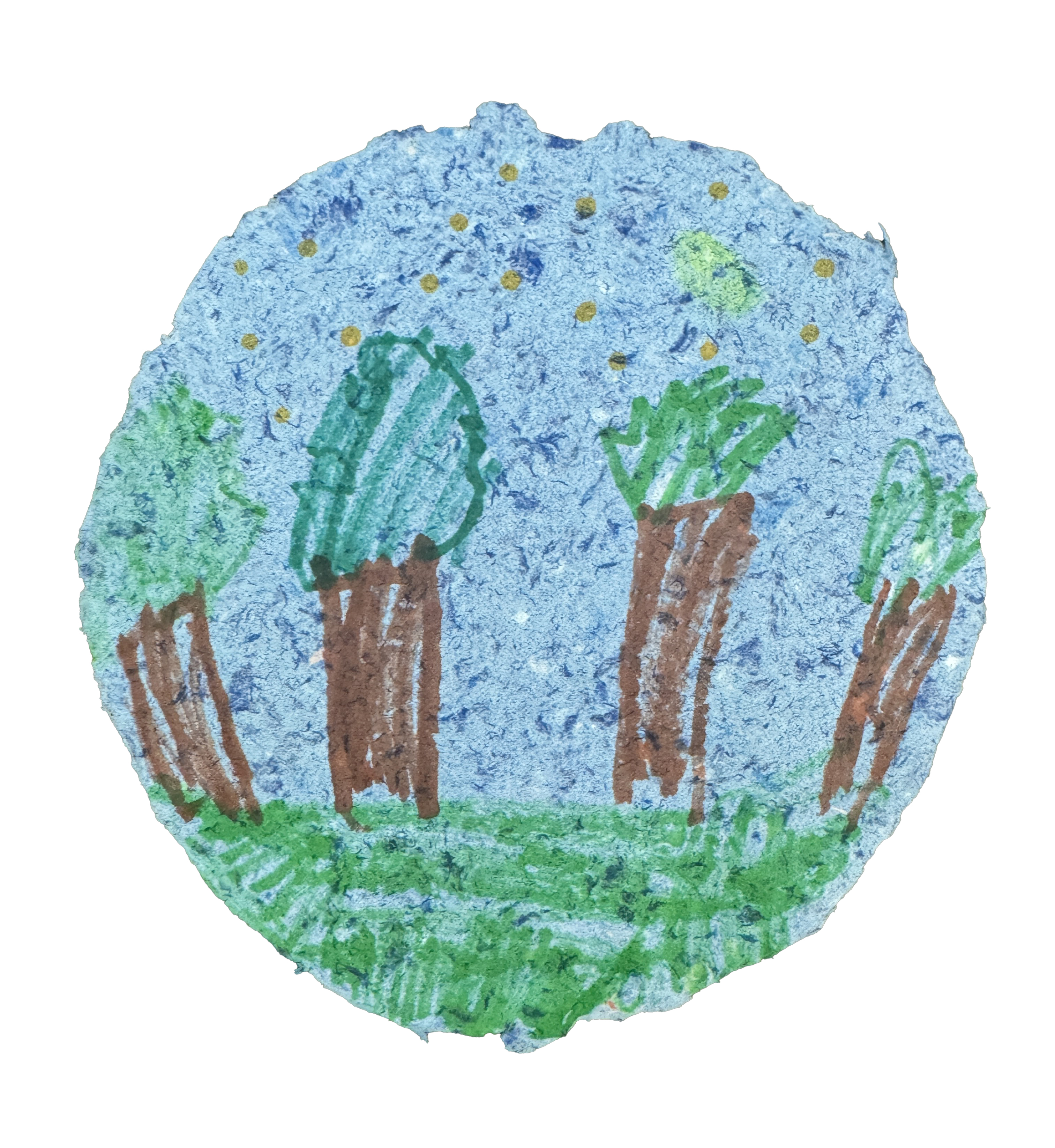


 She included a little note stating that the rounds were made by she and her family some time ago—seems perhaps a year ago? (Ah, yes, a reminder that it’s not about time.) So happy though that they’ve finally found their way to the Treewhispers project! She shared with me a link she has on her blog referencing the project and papermaking

 Photo by Pamela Paulsrud at the Chicago Botanic Garden Papermaking Event


 Photo by Pamela Paulsrud


![hdr_00034_0[1]](https://i0.wp.com/treewhispers.com/wp-content/uploads/2012/12/hdr_00034_01.jpg?resize=500%2C379)


 Photo by Pamela Paulsrud
 Photo by Pamela Paulsrud
 Photo by Pamela Paulsrud
 Photo by Pamela Paulsrud
 Photo by Pamela Paulsrud
 Photo by Pamela Paulsrud
 Photo by Pamela Paulsrud
 Photo by Pamela Paulsrud
 Photo by Pamela Paulsrud


 Photo by Pamela Paulsrud
 Photo by Pamela Paulsrud
 Photo by Pamela Paulsrud

 Photo by Pamela Paulsrud
 Photo by Pamela Paulsrud


